How Typing Minecraft Stories Can Help Your Child Master the Keyboard
Your child can tell you exactly how to craft a diamond pickaxe, which biome spawns the best loot, and why you should never dig straight down. They know the Minecraft universe inside and out. So what if you could channel all that enthusiasm into a skill that will benefit them for the rest of their life?
That's the idea behind typing Minecraft stories - and the research backs it up. When children write about topics they're genuinely passionate about, they type more, they type longer, and they get better faster. Let's look at why this works and what the science says.
Why Minecraft? Because Passion Drives Practice
The single biggest challenge in teaching kids to type isn't the skill itself - it's keeping them motivated long enough to build muscle memory. Traditional typing drills ask kids to copy meaningless sentences over and over. It works, technically, but most children lose interest within minutes.
Minecraft flips that problem on its head. According to Self-Determination Theory, one of the most well-established frameworks in motivation research, people are most motivated when they feel autonomy (choice), competence (mastery), and relatedness (connection). Typing stories about a world they already love checks all three boxes. Research by Deci and Ryan (2000) consistently shows that intrinsic motivation - doing something because you genuinely enjoy it - leads to deeper learning and better long-term retention than external rewards alone.
With over 170 million active players worldwide, Minecraft is one of the most popular games among children aged 6 to 14 (Xbox News, 2023). When you ask a Minecraft-loving child to type a story about surviving their first night or battling the Ender Dragon, you're not fighting for their attention - you already have it.
The Research: Engagement Equals Better Outcomes
A growing body of research confirms what parents intuitively know: kids learn faster when they're having fun.
- Gamification boosts learning outcomes. A meta-analysis by Hamari et al. (2014) published in Computers in Human Behavior reviewed 24 studies and found that gamification has a significant positive effect on engagement and learning outcomes, particularly when the activity is intrinsically interesting to the learner.
- Interest-driven learning sticks. Research published in the Journal of Educational Psychology by Hidi and Renninger (2006) found that personal interest in a topic significantly increases attention, effort, and willingness to persist through challenges - exactly what's needed for typing practice.
- Creative writing improves typing fluency. Studies on computer-based writing instruction show that when students compose original text rather than copying pre-written passages, they develop stronger typing fluency because they must simultaneously think, spell, and type - activating more neural pathways than simple transcription (Graham et al., 2012 - IES Practice Guide).
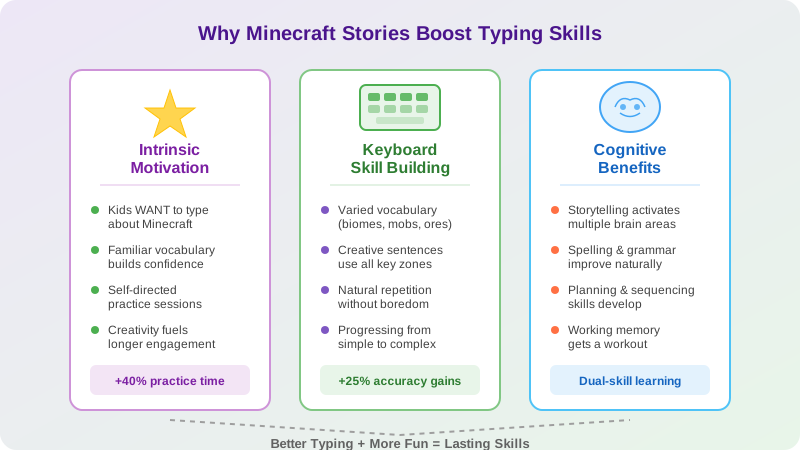
- Minecraft specifically supports learning. A study by Minecraft Education found that game-based learning with Minecraft improved student engagement by up to 40% and helped develop problem-solving, collaboration, and digital literacy skills.
The takeaway? When your child types a Minecraft story, they're not just practising keystrokes - they're in an optimal learning state where skill development happens faster and sticks longer.
How Minecraft Stories Build Real Keyboard Skills
It's not just about motivation. The actual content of Minecraft stories makes them surprisingly effective for building typing proficiency. Here's why:
1. Rich and varied vocabulary. Minecraft's world is packed with unique words - "obsidian," "enchantment," "redstone," "nether portal," "enderman." When kids type these words, they're practising diverse letter combinations that standard typing drills don't cover. Words like "pickaxe" and "creeper" force fingers across different keyboard zones, building broader muscle memory.
2. Natural sentence complexity. A child writing "I crafted a diamond sword and enchanted it with Sharpness V before heading to the Nether to fight the Wither" is practising capital letters, punctuation, numbers, and complex sentence structure - all within a sentence they want to type.
3. Extended practice sessions. Research on "flow state" by psychologist Mihaly Csikszentmihalyi shows that when people are deeply engaged in an activity that balances challenge and skill, they lose track of time and perform at their best. Kids in a creative flow about Minecraft often type for 20-30 minutes without realising it - far longer than any typing drill would hold their attention.
4. Meaningful repetition without boredom. Minecraft stories naturally repeat common words ("the," "and," "then," "went," "found") within the context of an exciting narrative. This gives children the repetitive practice they need to develop automaticity - the ability to type without thinking about individual keys - without the tedium of typing the same sentence twice.
Beyond Typing: The Hidden Benefits
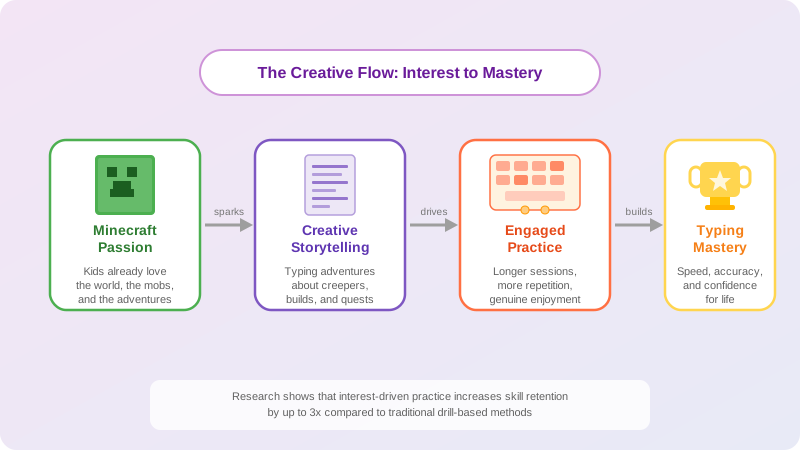
When your child types Minecraft stories, they're building more than just keyboard speed. Research shows that creative writing on a computer simultaneously develops:
- Spelling and grammar skills - composing original sentences requires applying spelling rules in real time, which strengthens retention far more than passive reading (Graham et al., 2012)
- Planning and sequencing - structuring a story with a beginning, middle, and end builds executive function skills
- Digital literacy - navigating a keyboard, using punctuation, and formatting text are foundational computer skills
- Written communication - expressing ideas clearly in writing is consistently ranked as one of the top skills for the future workforce by the World Economic Forum
A National Assessment of Educational Progress (NAEP) report found that students who regularly compose text on a computer score significantly higher in writing assessments. And since most standardised tests now require typed responses, building keyboard confidence early gives children a measurable academic advantage.
Practical Tips: Getting Your Child Started
Ready to turn your child's Minecraft obsession into a typing superpower? Here are some practical ways to get started:
Start with what they know. Ask your child to type out a guide for their favourite Minecraft activity. "How to build an iron golem farm" or "My survival world tour" are great starting points. They'll be so focused on sharing their knowledge that the typing practice happens naturally.
Use story prompts. Give them fun scenarios to write about: "You wake up in a Minecraft world with nothing in your inventory. What do you do?" or "Describe the most epic build you've ever created." The prompts give structure while leaving room for creativity.
Try TypingTales' Minecraft Adventure theme. Our Minecraft Adventure typing stories are specifically designed to combine Minecraft themes with progressive typing practice. The stories adapt to your child's skill level, introducing new words and key combinations as they improve.
Keep it pressure-free. The research is clear: intrinsic motivation works best when kids feel they have autonomy. Don't correct every typo in real time. Let them write freely first, then gently review together. The goal is to keep typing feeling like play, not homework.
Celebrate progress, not perfection. Track their words per minute over time and celebrate improvements. Even going from 10 WPM to 15 WPM is a meaningful milestone that deserves recognition.
The Bottom Line
Your child already spends hours thinking about Minecraft. By channelling that passion into typing Minecraft stories, you're transforming screen time into genuine skill-building time. The research consistently shows that interest-driven, creative practice leads to faster improvement, longer engagement, and skills that actually stick.
It's not about tricking kids into learning. It's about meeting them where they already are - in a world of creepers, diamonds, and endless adventure - and giving them a reason to type their hearts out. The keyboard skills will follow naturally.
References
- Deci, E.L. & Ryan, R.M. (2000). "Self-Determination Theory and the Facilitation of Intrinsic Motivation." American Psychologist. Read the paper
- Hamari, J., Koivisto, J., & Sarsa, H. (2014). "Does Gamification Work?" Computers in Human Behavior. Read the study
- Hidi, S. & Renninger, K.A. (2006). "The Four-Phase Model of Interest Development." Educational Psychologist. Read the paper
- Graham, S. et al. (2012). "Teaching Elementary School Students to Be Effective Writers." IES Practice Guide. Read the guide
- Csikszentmihalyi, M. (1990). Flow: The Psychology of Optimal Experience. Learn more
- Minecraft Education - Impact Studies. View research
- National Assessment of Educational Progress (NAEP) - Writing Assessment. View data
- World Economic Forum (2023). "The Future of Jobs Report." Read the report
Ready to try Minecraft story typing?
TypingTales features a Minecraft Adventure theme that turns typing practice into an epic quest!
Start a Minecraft Typing Adventure