From 10 to 40 WPM: A Realistic Roadmap for Increasing Kids' Typing Speed

Parents love benchmarks. It's completely natural - you want to know if your child is on track, falling behind, or ahead of the curve. When it comes to typing, the question we hear most often is some version of: "Is my child's typing speed normal for their age?"
The short answer is: there's a wide range of "normal," and speed isn't the only thing that matters. But if you want realistic targets and a practical plan to help your child improve, you're in the right place. Let's break it down.
What's a Normal Typing Speed for Kids?
Here are some general benchmarks based on age and experience level. These aren't rigid standards - they're averages drawn from educational research and typing assessment data. Every child is different, and factors like how long they've been practising, whether they use proper technique, and how often they type all play a role.
- Ages 6-7 (Year 1-2): 5-15 WPM. At this age, kids are still developing fine motor skills. Many are just learning where the letters are. Any typing at all is progress
- Ages 8-9 (Year 3-4): 15-25 WPM. Kids who've had some practice start building speed here. This is the sweet spot to introduce proper finger placement if they haven't started already
- Ages 10-11 (Year 5-6): 20-35 WPM. With regular practice, kids in this age range can develop solid touch typing skills. Many schools start expecting typed assignments around this age
- Ages 12-13 (Year 7-8): 30-45 WPM. By secondary school, regular typists should be approaching adult-like speeds. Some kids hit 50+ WPM with dedicated practice
Important caveat: these numbers assume the child is using proper touch typing technique. A hunt-and-peck typist might hit 20 WPM, but they'll plateau there. Proper technique has a much higher ceiling.
Speed vs. Accuracy: Which Matters More?
This is the mistake most people make when tracking typing progress: they focus entirely on WPM and ignore accuracy. Here's the truth - accuracy matters more than speed, especially for learners.
A child typing at 20 WPM with 95% accuracy is in a better position than a child typing at 30 WPM with 80% accuracy. Why? Because the fast, inaccurate typist is building bad habits. They're guessing, rushing, and reinforcing incorrect finger movements. The slower, accurate typist is building clean muscle memory that will naturally speed up over time.
The rule of thumb: aim for 95% accuracy before trying to increase speed. Speed will come naturally once the technique is solid. Chasing speed too early is the most common reason kids develop bad typing habits that are hard to fix later.
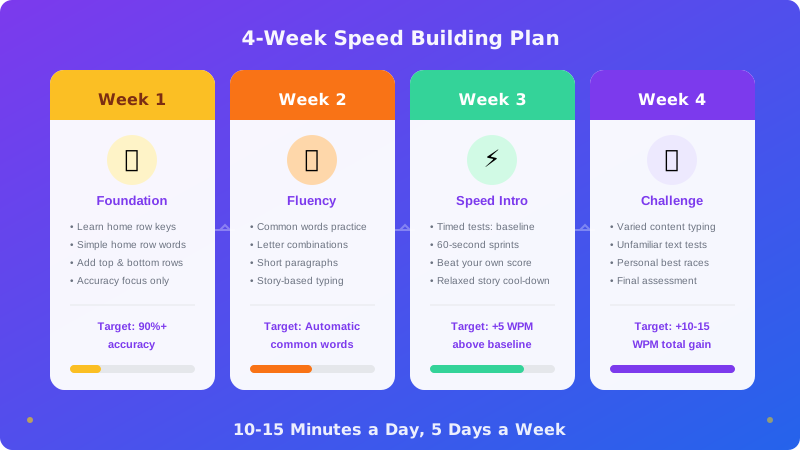
The 4-Week Speed-Building Plan
Here's a realistic practice plan that works for most kids aged 8-12. It assumes 10-15 minutes of practice per day, 5 days a week. Adjust the pace for younger or older children.
Week 1: Foundation (Home Row Focus)
The goal this week is pure technique, not speed. If your child doesn't already know the home row (A, S, D, F, J, K, L), this is where to start.
- Days 1-2: Learn the home row keys. Practise typing simple words that use only home row letters (ask, fall, lads, salad). Focus on keeping fingers on the correct keys
- Days 3-4: Add the keys directly above and below the home row. Practise short sentences that use the top and bottom rows
- Day 5: Full keyboard practice with simple sentences. No speed pressure - accuracy only
Target by end of week: Comfortable with finger positions. Speed doesn't matter. Accuracy above 90%.
Week 2: Building Fluency
Now that finger positions are established, it's time to build fluency - the ability to type common words without thinking about each letter.
- Days 1-3: Type common words and short phrases. Focus on common letter combinations (th, er, ing, tion). Repeat familiar words until they feel automatic
- Days 4-5: Move to short paragraphs. Story-based typing is ideal here - it keeps attention focused while building fluency naturally
Target by end of week: Noticeable increase in comfort. Starting to type some words without consciously thinking about each letter. Accuracy should stay above 90%.
Week 3: Speed Introduction
This is where speed starts to matter - but only alongside maintained accuracy.
- Days 1-2: Do a timed test at the start of each session to establish a baseline. Then practise normally. End with another timed test to see the warm-up effect
- Days 3-5: Introduce "sprint" sessions - 60-second bursts where the goal is to type as fast as possible while maintaining 90%+ accuracy. Follow each sprint with 5 minutes of relaxed story typing
Target by end of week: A measurable speed increase (even 3-5 WPM is significant). Accuracy still above 90%. The child should feel noticeably more comfortable than Week 1.
Week 4: Consolidation and Challenge
The final week is about pushing the boundaries while keeping everything they've learned.
- Days 1-2: Longer typing sessions with varied content. Mix stories, sentences, and individual word practice. Track WPM and accuracy for each session
- Days 3-4: Challenge activities - typing races against their own best score, or typing unfamiliar text (not just practised passages) to test real-world speed
- Day 5: Final assessment. Compare Week 4 speed and accuracy to Week 1. Celebrate the progress
Typical results after 4 weeks: Most children see a 10-15 WPM improvement with consistent daily practice. A child starting at 10 WPM might reach 20-25. A child starting at 20 WPM might reach 30-35. The gains are real and measurable.
What Happens After the 4 Weeks?
The plan doesn't end at Week 4 - that's just the initial boost. Continued progress comes from regular practice. The good news is that by Week 4, most kids have built enough skill and confidence that typing feels natural rather than forced. Switching to story-based typing platforms for ongoing practice keeps the momentum going without it feeling like a structured programme.
The speed gains also compound. Going from 10 to 20 WPM feels slow and hard. Going from 20 to 30 feels easier. And going from 30 to 40 often happens almost without the child noticing, because by that point their muscle memory is doing most of the work.
The Bottom Line
Your child's typing speed is a journey, not a destination. Whether they're at 10 WPM or 30 WPM right now, the path to improvement is the same: proper technique first, accuracy second, speed third. Follow a structured practice plan, keep sessions short and engaging, and track progress so they can see how far they've come. The WPM will follow.